[Did you know that I started this post over two weeks ago, started writing it while my greens were on the stove and overcooked my greens, and didn't look at my photos until just today... only to discover that not a single shot turned out? Yes. I am an epic blogger. Oh well.]
Have you had collard greens? Do you remember, by any chance... what color they were?
It seems like a silly question, I know, and I wish it were. But bear with me here for a sec - were they by any chance... kinda brown?
I'm a fan of some traditional recipes. I believe that, when it comes to food, traditions are made for a reason, and I've given traditional collard greens a try several times. And I'm tired of eating collard browns. So here, I'll just go ahead and say it:
You're probably cooking your greens wrong.
I'm a firm believer, with some exceptions, that vegetables should be brighter in color when you serve them than they were raw, and traditional recipes for collards have you cook your greens for 45, 60 minutes - I've seen up to two hours. They're not going to be green anymore. I'm skeptical they will be food. You'll also sacrifice significant Vitamin C content, as it's not especially heat stable (not that most Americans have trouble getting enough C).
A few years ago, I had a bunch of greens in the fridge and wanted them for lunch. Knowing that I didn't particularly care for the traditional long-cooked style, I started hunting for a new approach. I'm not sure exactly what search terms I used to led me to this Epicurious recipe, but I do know that I am forever grateful to them. I basically haven't cooked hardy greens any other way since then, and this is essentially still the exact recipe I use, though I sometimes use thinly sliced onions instead of garlic, often add crushed red pepper, and always, always finish with a splash of lemon. The one caveat I'll add is that the cooking time does vary widely. I've had tender, smaller leaves that cooked up in 3-4 minutes, but it's not always the case. The greens I was cooking for this post were larger than some pets I've had, and they needed nearly ten minutes to get past that "eating roughage" texture. Either way, though, ten minutes beats an hour or more, and you end up with a quick dish that's more attractive and healthier. If that ain't a trifecta, I don't know what is.
As I said, my photos turned out terribly, but contrasting two Google image searches tells all the story you need: Brazilian collard greens vs. collard greens.
I guess this one photo didn't turn out too badly, so I'll toss it in here just to break up the text.
Wednesday, November 21, 2012
Friday, October 19, 2012
How did I get so lucky?
I got home from the hospital today, and Keith had decided to throw together something a little nice for dinner. Now, I'm no slouch in the kitchen, but when I decide to throw something nice together, it's, I dunno, a really tasty stir fry. Totally worth eating, but still... stir fry.
My husband? Throws this nonsense together:
That's red quinoa with sauteed butternut squash, arugula and farmers market tomatoes tossed in a red wine vinaigrette, toasted almonds, and three big fat sea scallops topped with black Hawaiian salt.
Be still my tummy! What a wonderful, healthy and delicious meal. Not necessarily light, but packed with so many great ingredients and beautiful colors, I don't really care that it's a little high in fat.
I will leave you with a shot of a perfectly seared scallop. You know one when you see one.
Thursday, October 18, 2012
One Day on a Ketogenic Diet
Last week in my Nutrition & Metabolism class, we were discussing... well, metabolism, in particular the ketogenic processes in the body. One of the ways our teacher keeps the material fresh is by incorporating surprising real life applications and experiences, sometimes from his work as a clinical dietitian. I think the entire class was surprised to learn that an extreme ketogenic diet is used in some cases to treat severe epilepsy in children. How extreme? Well, a typical 1500 calorie diet would include about 42g fat, 205g carbohydrates, and 75g protein - these are numbers that fall inside the Acceptable Macronutrient Distribution Range.
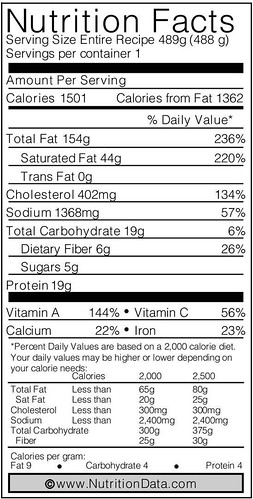
We were asked to create one day of a diet that contained 1500 calories, 150g fat, 18g carbohydrates, and 20g protein.
Yeah.
Our initial giggly thoughts centered on, you know, "Here's a cup of olive oil. Bottom's up!" But our teacher was quick to bring us back to the human element: "Remember, this is a little kid you've got sitting across from you, and you have to tell him this is what he's going to eat for the next few months or years."
I'm an emotional mess lately, so I got a little weepy thinking about that.
Not surprisingly, without access to a lot of nutrition information, no one was able to come up with a whole day's diet, but a few suggestions were thrown out: egg yolks, bacon, ranch dressing, butter, oil. I managed to look up a few items on my phone and was surprised by their nutrition info when viewed through this lens. Avocados? Not actually high enough in fat for this diet - too much carb and protein! I knew bacon was a good source of fat, but I didn't realize just how much more fat it has than protein. Very useful. And pecans? My friends: they are higher in fat than you imagine. I found the discussion really interesting and decided to finish the activity on my own.
I finally managed to come up with a diet that's at least made of actual food. It's interesting to look at this and realize that, for all its 154g of fat, there just... isn't much food here. And just this one day took me probably an hour to come up with. I kept trying to maintain some normalcy - I started with one slice of bread at breakfast, which turned into half a slice, then a quarter slice, and then it disappeared because an eighth of a slice of bread is way sadder than no bread. It's hard to imagine trying to create a diet based on these restrictions that is tolerable day in, day out for months. I'd almost rather drink my cup of oil and be done with it.
Here's one day on an extreme ketogenic diet:
Breakfast
3.5oz very high fat bacon, all drippings included
1 egg yolk, cooked in bacon fat
Lunch
1oz shredded green cabbage, tossed in 2tbsp ranch dressing
4oz celery, dipped in 2tbsp ranch dressing
Snack
.5oz pecans
Dinner
2oz spinach, cooked in 2tbsp canola oil
Dessert
Hot cocoa made with:
2.5oz cream, diluted with water
2tsp cocoa powder
Artificial sweetener to taste
The full day's nutritional analysis is at the top of the post.
Isn't that depressing? Can you imagine being four years old and hearing this is what you'll eat? This little project served as a good reminder of the power we have as dietitians, and the power food has in people's lives, and how very careful we have to be not to abuse either.
We were asked to create one day of a diet that contained 1500 calories, 150g fat, 18g carbohydrates, and 20g protein.
Yeah.
Our initial giggly thoughts centered on, you know, "Here's a cup of olive oil. Bottom's up!" But our teacher was quick to bring us back to the human element: "Remember, this is a little kid you've got sitting across from you, and you have to tell him this is what he's going to eat for the next few months or years."
I'm an emotional mess lately, so I got a little weepy thinking about that.
Not surprisingly, without access to a lot of nutrition information, no one was able to come up with a whole day's diet, but a few suggestions were thrown out: egg yolks, bacon, ranch dressing, butter, oil. I managed to look up a few items on my phone and was surprised by their nutrition info when viewed through this lens. Avocados? Not actually high enough in fat for this diet - too much carb and protein! I knew bacon was a good source of fat, but I didn't realize just how much more fat it has than protein. Very useful. And pecans? My friends: they are higher in fat than you imagine. I found the discussion really interesting and decided to finish the activity on my own.
I finally managed to come up with a diet that's at least made of actual food. It's interesting to look at this and realize that, for all its 154g of fat, there just... isn't much food here. And just this one day took me probably an hour to come up with. I kept trying to maintain some normalcy - I started with one slice of bread at breakfast, which turned into half a slice, then a quarter slice, and then it disappeared because an eighth of a slice of bread is way sadder than no bread. It's hard to imagine trying to create a diet based on these restrictions that is tolerable day in, day out for months. I'd almost rather drink my cup of oil and be done with it.
Here's one day on an extreme ketogenic diet:
Breakfast
3.5oz very high fat bacon, all drippings included
1 egg yolk, cooked in bacon fat
Lunch
1oz shredded green cabbage, tossed in 2tbsp ranch dressing
4oz celery, dipped in 2tbsp ranch dressing
Snack
.5oz pecans
Dinner
2oz spinach, cooked in 2tbsp canola oil
Dessert
Hot cocoa made with:
2.5oz cream, diluted with water
2tsp cocoa powder
Artificial sweetener to taste
The full day's nutritional analysis is at the top of the post.
Isn't that depressing? Can you imagine being four years old and hearing this is what you'll eat? This little project served as a good reminder of the power we have as dietitians, and the power food has in people's lives, and how very careful we have to be not to abuse either.
Sunday, September 30, 2012
Roasted Chickpeas
As usual, I have failed at a timely leap onto the bandwagon. How long have roasted chickpeas been a thing? Honestly, I don't know, because I am that terrible at the bandwagon.
I love chickpeas, so the first time I heard of roasted chickpeas, maybe a couple of years ago, I instantly thought, "I will love this snack." And yet, I never made them until this week. I'm not sure why. I had no reason to doubt that I would indeed love them. It's not like it's a particularly labor-intensive recipe. I just... didn't.
The concept's pretty simple. Drain and rinse a can of chickpeas well, dry them thoroughly, remove the skins if you like, coat with olive or canola oil and the seasoning of your choice, and roast away. Try not to eat the whole thing.
These are a great snack, definitely a healthier alternative to chips (though I'm not sure they satisfy the same cravings), but the light crunch makes it very easy to overeat and consume a whole batch in one sitting. There are two major downsides to that: you've just consumed about 500 calories of "snack," and you've just consumed about 20 grams of fiber in as many minutes. I love fiber and regularly exceed the ~30g daily recommendation (by a lot), but still... yikes. That'll getcha movin'. So portion those bad boys out into about 1/3 cup servings, and share the love.
In that serving, you'll get about 6g fiber and protein each (I'm not sure how much difference skin on/off makes in fiber content), as well as a great boost to your daily intake of B6, folate, and manganese, and if you use canola oil, nearly half of the (small amount of) fat is polyunsaturated - and we love our essential fatty acids, don't we? Yes, we do. Say it now, "We love our essential fatty acids."
Ahem. Anyway.
I haven't quite honed my technique yet, but here are a few things I've picked up. Removing the skins is optional, but they take a little longer to bake if you don't, and I think I do slightly prefer the skin-off version. It might seem tempting to make a big batch of these at once and save them, but the quality takes a pretty steep nosedive about an hour out of the oven. We had some success reviving them in the microwave, but that process also resulted in a crazy lightning storm in our microwave (twice!), possibly due to this phenomenon (or the magnetron just bit the dust), so, uh... proceed with caution.
Roasted Chickpeas
Serves 3... or possibly 1
- One can chickpeas, rinsed, drained, (optionally) skins removed
- 1-2 tsp olive or canola oil
- 1/4 tsp salt (optional - I skipped it, and the beans were plenty well seasoned)
- 1 tsp seasoning blend of your choice (make sure you note if it contains salt)
Preheat oven to 400ºF (I used 350ºF and convection). Toss beans evenly with oil, salt, and seasoning, and spread on baking sheet. Bake 30-45 minutes, until crispy and dry but not hard. Shake pan once or twice during cooking time.
Optional: practice restraint.
Friday, September 14, 2012
The Incredible, Inedible Egg?
Oh, eggs.
Did you hear? Surely you did, since it was news a month ago, also known as "One of the many times during which Becka was not updating her blog." Eggs are killing us again.
I won't comment (much) on the quality of the study, other than to make sure we notice the "we didn't look at overall dietary patterns" thing, which... seems like something you might want to do.
I used to be an egg hater. Of course, I loved eggs in all things baked, and I had the occasional craving for a good eggs benedict (or variation thereof), but for the most part I was glad to take a pass. I thought they were bland and boring, and with their ~200mg of cholesterol each, I thought they were death traps. Within the last few years, though, I discovered good eggs. I'm not talking about the mass-marketed organic eggs that are a step up in quality but seven steps up in price. I'm talking about truly wonderful eggs from a local farm, or better yet, from a local friend. Eggs from chickens whose owners couldn't quite tell you what their birds eat, because their birds are allowed to hunt their own food. Eggs that are highly variable in shape, size, and - my favorite - color, and whose yolks burst forth when you crack them open, vibrantly orange and standing up proud and tall.
Yes, folks. I once was an egg hater, and now I wax poetic on eggs. But... look at them!
The thing about these eggs is that they're not just prettier and tastier. They may be healthier, too. Studies have found that eggs from pastured chickens may be lower in saturated fat and have a healthier ratio of omega-3 fats. And the cholesterol? Well, as far as my understanding goes, dietary cholesterol isn't a good predictor of blood cholesterol anyway.
Should we listen to the newest studies telling us our favorite foods are analogous to smoking a pack a day? Sure, but with a grain of whichever seasoning you like. This study has flaws, and doesn't seem to account for people eating truly good eggs.
So my advice? Keep eggs in your diet, but as always, practice moderation. Eggs shouldn't be your only source of protein. Pair a great diet with regular exercise, and hereditary factors notwithstanding, the saturated fat and cholesterol in eggs are likely to be a non-issue for you. But don't forget: eat some truly good eggs! Get them from a nearby farmer and support your local community and animal welfare. They'll cost more, yes, but they'll give you so much more in return.
Did you hear? Surely you did, since it was news a month ago, also known as "One of the many times during which Becka was not updating her blog." Eggs are killing us again.
I won't comment (much) on the quality of the study, other than to make sure we notice the "we didn't look at overall dietary patterns" thing, which... seems like something you might want to do.
I used to be an egg hater. Of course, I loved eggs in all things baked, and I had the occasional craving for a good eggs benedict (or variation thereof), but for the most part I was glad to take a pass. I thought they were bland and boring, and with their ~200mg of cholesterol each, I thought they were death traps. Within the last few years, though, I discovered good eggs. I'm not talking about the mass-marketed organic eggs that are a step up in quality but seven steps up in price. I'm talking about truly wonderful eggs from a local farm, or better yet, from a local friend. Eggs from chickens whose owners couldn't quite tell you what their birds eat, because their birds are allowed to hunt their own food. Eggs that are highly variable in shape, size, and - my favorite - color, and whose yolks burst forth when you crack them open, vibrantly orange and standing up proud and tall.
Yes, folks. I once was an egg hater, and now I wax poetic on eggs. But... look at them!
The thing about these eggs is that they're not just prettier and tastier. They may be healthier, too. Studies have found that eggs from pastured chickens may be lower in saturated fat and have a healthier ratio of omega-3 fats. And the cholesterol? Well, as far as my understanding goes, dietary cholesterol isn't a good predictor of blood cholesterol anyway.
Should we listen to the newest studies telling us our favorite foods are analogous to smoking a pack a day? Sure, but with a grain of whichever seasoning you like. This study has flaws, and doesn't seem to account for people eating truly good eggs.
So my advice? Keep eggs in your diet, but as always, practice moderation. Eggs shouldn't be your only source of protein. Pair a great diet with regular exercise, and hereditary factors notwithstanding, the saturated fat and cholesterol in eggs are likely to be a non-issue for you. But don't forget: eat some truly good eggs! Get them from a nearby farmer and support your local community and animal welfare. They'll cost more, yes, but they'll give you so much more in return.
Sunday, September 9, 2012
Your RDA of Snake Oil is Zero
I've had this post floating around in my head for several months, but haven't put it to words for a variety of reasons. First, I feel a bit guilty about working on blog stuff when the semester that I believe is known among senior FND majors at my school as "Hell semester" has begun, and I should be working on homework. Somehow, twitter and facebook do not elicit this same guilt.
Second, it's just a touchy subject, and I have to be very careful here, because it's a direct criticism of one of my colleagues/peers. While what I have to say is important, and - obviously, in my opinion - valid, it's equally important to say it respectfully, and I'd rather take my time with a post like this and do it right than ruffle feathers in the wrong way. I'm okay with a little ruffle, though - think of it as flair.
I happen to know this young woman, who has graduated and is currently working on her internship. She was (is, presumably) a great student, very active in the department and community, and was in demand. I have no doubt she was on numerous internships' top match lists. Though we've never been close friends, I follow her on facebook. I noticed a few months ago that a significant portion of her posts were, essentially, shilling for the diet shake program she's a part of. Recipes, links to join or team or whatever, comments about the great indulgent 47 calorie shake she had for breakfast, etc.
So never mind the fact that I probably outweigh her by 40 pounds or more (because, really, that is not the issue here), and never mind every "Hi, I'm a pyramid scheme!" red flag in the book. My real problem here is that I believe, in selling this program, she is doing a great disserve to herself, to the dietetics profession as a whole, and to our clients.
Listen, as much as we'd like to believe otherwise, eating a great diet is kind of hard. If it weren't, most of us would be out of a job, right? So it's important to acknowledge that to our clients. To help people through a challenge, it is absolutely vital that you agree with them that some challenge exists. But you have to balance that with a commitment to the path through the challenge. You have to show your clients, and the community as a whole, that while it does take some work to eat healthfully, it can be done, and it can be done with food. I believe a dietitian whose diet is significantly comprised of diet shakes is sending the message, essentially, that the only way to a healthy diet is cheating. As I've said before, by no means do I believe that dietitians should be required to set a flawless example with every bite they eat, but in the big picture, practice what you preach.
And whether this person is advising whole foods nutrition while her own diet is filled with low-cal shakes, or whether she is actually advertising this product as a dietitian (and not just as an independent person), she is wasting her intelligence and her skill, and not providing the service she has the capacity to do.
Please, please: do not be that dietitian. We can do better than this.
Second, it's just a touchy subject, and I have to be very careful here, because it's a direct criticism of one of my colleagues/peers. While what I have to say is important, and - obviously, in my opinion - valid, it's equally important to say it respectfully, and I'd rather take my time with a post like this and do it right than ruffle feathers in the wrong way. I'm okay with a little ruffle, though - think of it as flair.
I happen to know this young woman, who has graduated and is currently working on her internship. She was (is, presumably) a great student, very active in the department and community, and was in demand. I have no doubt she was on numerous internships' top match lists. Though we've never been close friends, I follow her on facebook. I noticed a few months ago that a significant portion of her posts were, essentially, shilling for the diet shake program she's a part of. Recipes, links to join or team or whatever, comments about the great indulgent 47 calorie shake she had for breakfast, etc.
So never mind the fact that I probably outweigh her by 40 pounds or more (because, really, that is not the issue here), and never mind every "Hi, I'm a pyramid scheme!" red flag in the book. My real problem here is that I believe, in selling this program, she is doing a great disserve to herself, to the dietetics profession as a whole, and to our clients.
Listen, as much as we'd like to believe otherwise, eating a great diet is kind of hard. If it weren't, most of us would be out of a job, right? So it's important to acknowledge that to our clients. To help people through a challenge, it is absolutely vital that you agree with them that some challenge exists. But you have to balance that with a commitment to the path through the challenge. You have to show your clients, and the community as a whole, that while it does take some work to eat healthfully, it can be done, and it can be done with food. I believe a dietitian whose diet is significantly comprised of diet shakes is sending the message, essentially, that the only way to a healthy diet is cheating. As I've said before, by no means do I believe that dietitians should be required to set a flawless example with every bite they eat, but in the big picture, practice what you preach.
And whether this person is advising whole foods nutrition while her own diet is filled with low-cal shakes, or whether she is actually advertising this product as a dietitian (and not just as an independent person), she is wasting her intelligence and her skill, and not providing the service she has the capacity to do.
Please, please: do not be that dietitian. We can do better than this.
Sunday, July 1, 2012
I don't wanna be a food stylist when I grow up.
I've been developing recipes for a handout on "Farmers Market Cooking" over the past few weeks, and since I wrote them myself and needed to photograph them, testing was required. I thought it might be fun, and I did enjoy the cooking aspects of it, of course, but it turns out while some basic food styling is fairly easy...
Others are, um... less so. Seriously, how does anyone ever style a dish like this? The best I could manage was "its best side."
I was reminded of one nice advantage of food photography, though: it only matters what it looks like. For this pesto - the recipe is actually written for basil - I used arugula. Arugula that turned out to be more mature than I thought. Arugula so bitter that no matter how much lemon juice and salt I added to it, produced an absolutely inedibly bitter pesto.
Also, that basil? It's a lie. It's from the renegade plant I posted last time - a plant I have since ripped out by its roots and tossed into the yard with disgust - and, damnit it is not basil. I have no idea what's wrong with it, or wrong with our soil, or wrong with me, but I cannot for the life of me grow basil that tastes like basil. It has a hint of that glorious basil flavor, buried under a mountain of this awful astringent, medicinal taste. It makes my tummy sad.
Of course, the one clear advantage of a recipe testing frenzy is having lots of delicious food fill the house, and fortunately everything I made - except that damn pesto - did turn out quite delicious. For this salsa, Keith tossed some locally grown hydroponic tomatoes on the grill to char up, and the glorious smokiness really elevated it. Not surprisingly, the salsa was not long for this world.
This grunt was pretty directly adapted from Alton Brown's grunt recipe, and it was by far the last dish to be made, in part because ugh am I really going to turn the oven on for an hour in the middle of this heat?, and in part because I'd burned myself out on recipe testing by then. The peaches sat on the counter for a week and barely made it through my holdout. Keith's first comment on this photo was, "You should've wiped the rim." Thanks, butthead.
Fortunately some dishes are hard to get any way but right. I've never come across a bruschetta that I wasn't thankful for, and this is no exception.
Subscribe to:
Posts (Atom)